
VPN Protocols Explained: WireGuard, OpenVPN, and IPsec Compared
August 31, 2026 · 3 min read
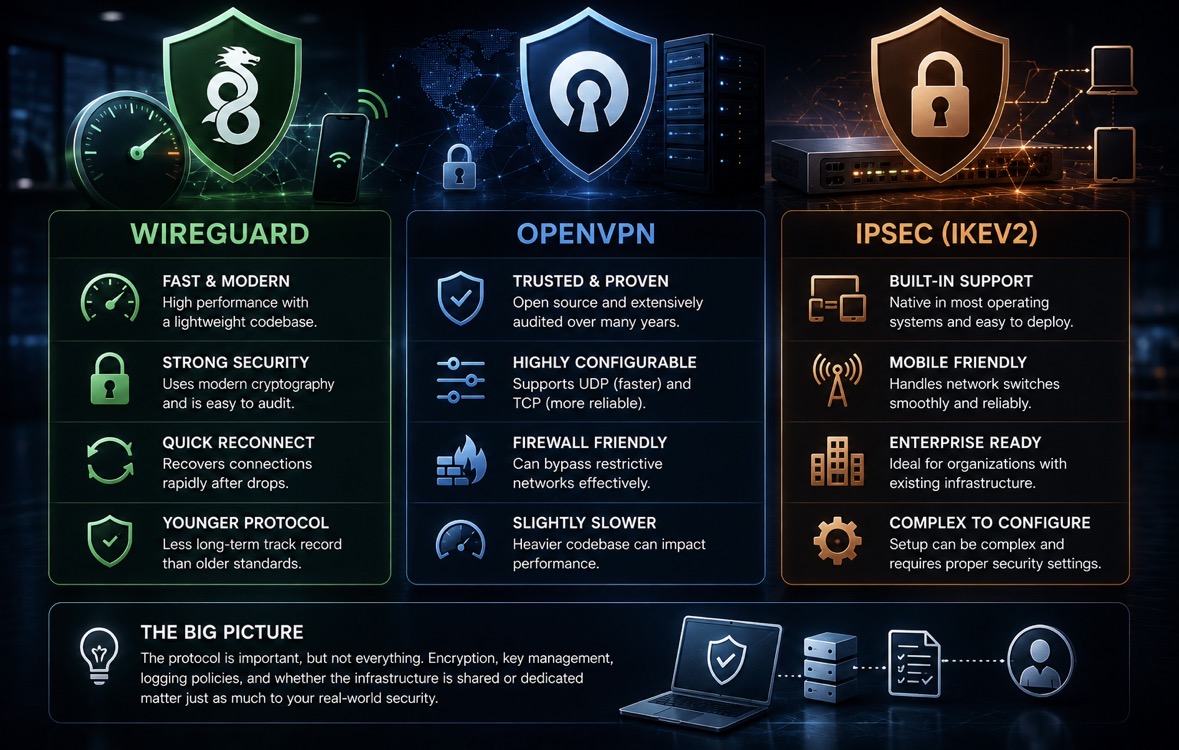
Every VPN runs on a protocol, the underlying set of rules that determines how data gets encrypted and tunneled between a device and its destination. Most users never think about it, and most providers don’t make you choose. But for a business evaluating a VPN solution seriously, the protocol behind it affects speed, security, and reliability in ways worth understanding before committing to a product.
WireGuard
WireGuard is the newest of the three and has become the default choice for a lot of modern VPN providers, for good reason. It’s built on a much smaller codebase than older protocols, which makes it easier to audit for vulnerabilities and generally faster to run. It uses modern cryptographic standards and tends to reconnect quickly after a dropped connection, which matters for mobile devices switching between networks.
The tradeoff is that WireGuard is younger, which means less of a long-term track record compared to protocols that have been battle-tested for two decades. In practice, that gap has narrowed significantly, and most security audits of WireGuard have come back favorable.
OpenVPN
OpenVPN has been the industry standard for years, and for a long time was the safest default choice. It’s open source, extensively audited, and highly configurable, supporting both a faster (UDP) and a more reliable (TCP) mode depending on network conditions. It’s also very effective at getting through restrictive firewalls, since its traffic can be disguised to look like standard web traffic.
The downside is that it’s generally slower than WireGuard due to a heavier codebase, and its setup can be more involved. For businesses that value a long history of scrutiny and proven reliability over raw speed, it remains a solid choice.
IPsec (often paired with IKEv2)
IPsec, usually implemented as IKEv2/IPsec, is common in enterprise environments and built into many operating systems natively, which makes it easy to deploy without extra software. It’s known for being stable on mobile connections, handling network switches (like Wi-Fi to cellular) smoothly without dropping the tunnel.
It tends to be a strong choice for organizations already invested in enterprise networking infrastructure, though it can be more complex to configure correctly compared to WireGuard, and past implementations have had documented vulnerabilities when configured with weak encryption settings.
How to Think About Choosing One
For most modern businesses, WireGuard offers the best balance of speed and security and is a reasonable default. OpenVPN is worth prioritizing when working in environments with strict firewalls or when a long audit history is a specific requirement. IPsec makes sense for organizations already running enterprise network infrastructure that supports it natively, or where built-in OS support simplifies deployment across a large device fleet.
The protocol matters, but it’s one piece of a larger decision. How the provider handles key management, what logging policies are in place, and whether the infrastructure itself is shared or dedicated all affect the actual security a business ends up with, regardless of which protocol sits underneath.